Reliable Vending Services for Irvine Warehouses
October 22, 2026 · 17 min read
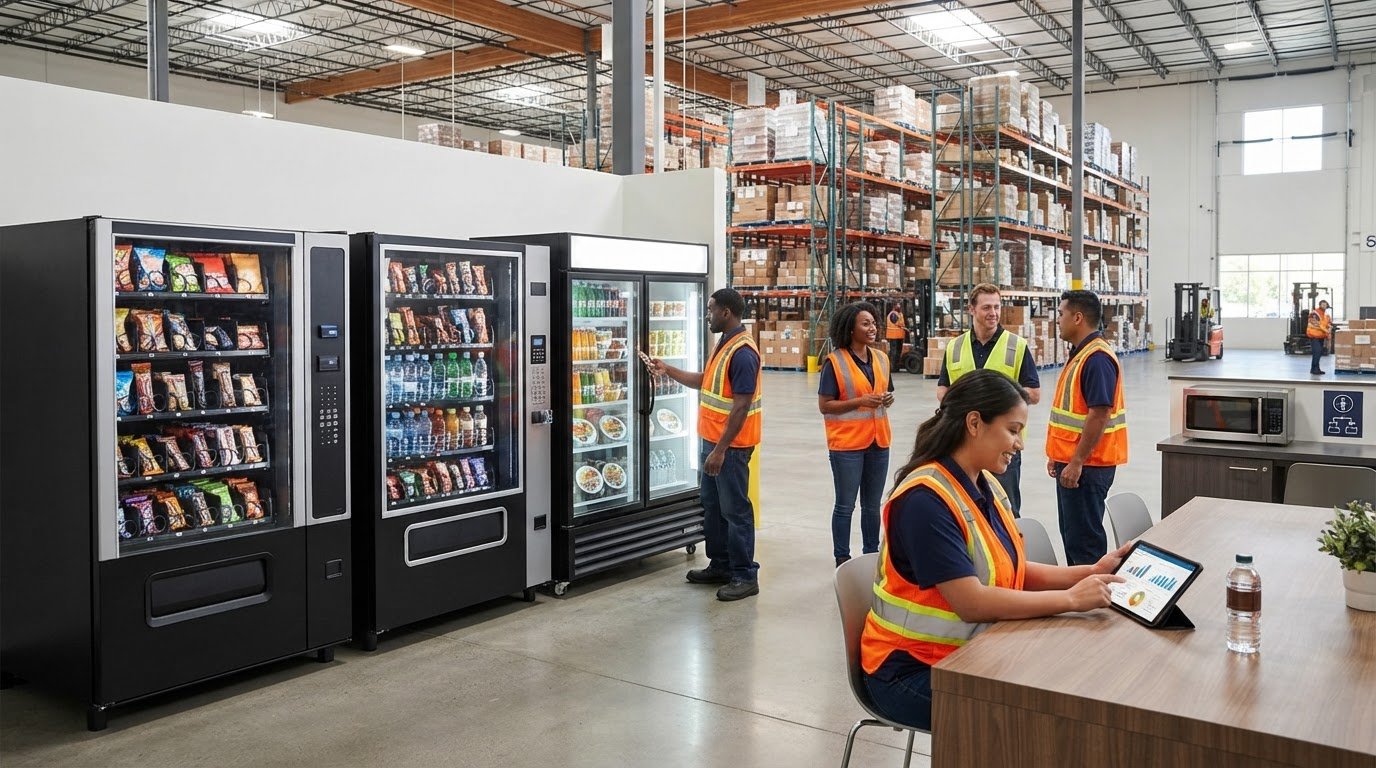
Yes, vending services for a warehouse can support inventory tracking across locations by bringing machine-level sales and stock information into a shared review. Reviewing product demand and replenishment needs helps teams spot popular items and reduce the chance of empty machines. The process can also account for different needs across sites and shifts.
Keeping warehouse vending stocked shouldn’t mean guessing what employees need or chasing updates from each location. A clear inventory process helps facility teams see what’s moving, plan replenishment, and compare service options with less day-to-day oversight.
This guide explains how inventory tracking works across warehouse locations, what to consider when choosing a vending setup, and which factors shape service costs. It also covers how product mix, machine placement, and restocking can support teams on different shifts, helping you assess options against your operation’s needs.
Key Takeaways
- Match the setup to your warehouse’s layout, employee access needs, and breakroom routines before comparing service options.
- Use shared inventory visibility to review stock and sales across locations, then adjust each site’s product mix to local demand.
- Plan replenishment around stocking patterns and demand peaks to help prevent popular items from running out.
- Compare service costs by considering factors such as equipment, product selection, placement, and replenishment needs.
- Choose a vending program that fits your operation’s workforce and locations, rather than relying on a one-size-fits-all setup.
Should Your Warehouse Sign for Vending Machines, Smart Coolers, or a Market?
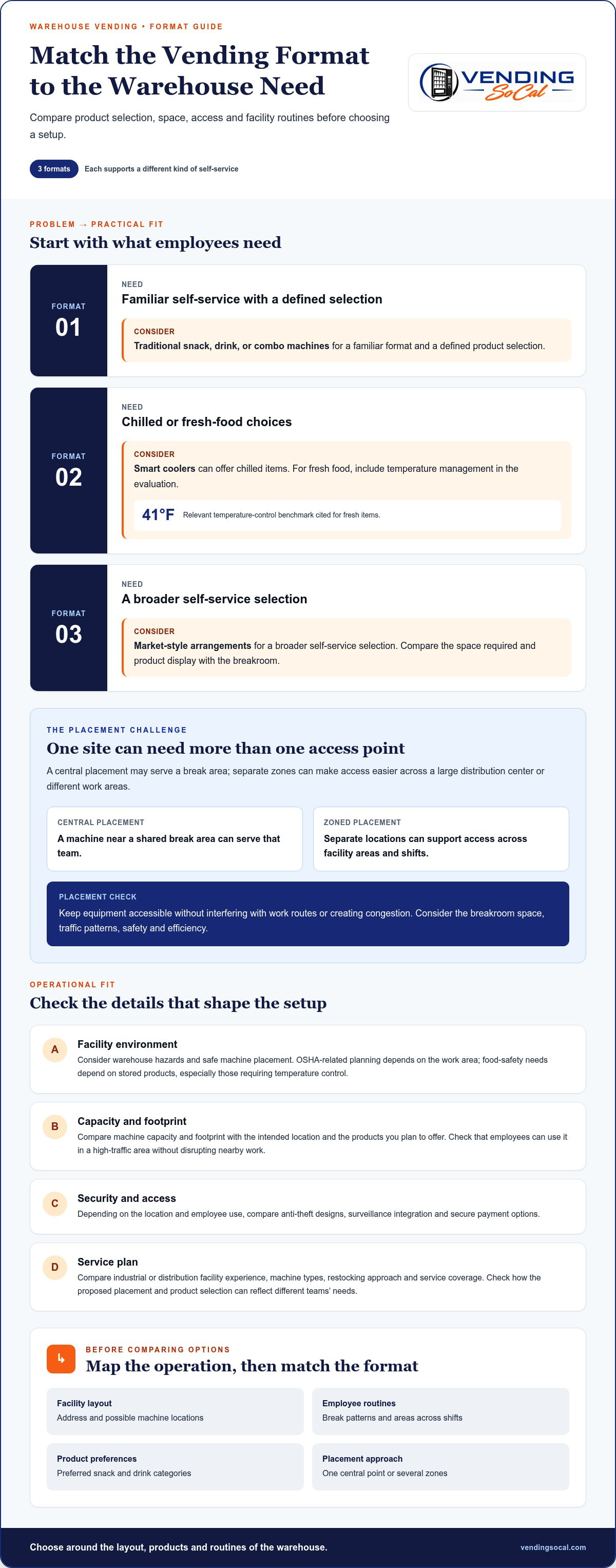
For warehouse and logistics operations, start by matching the vending format to employees’ access needs and the facility layout. Machines can provide convenient access throughout the day, while central or zoned placement can serve different areas of a large site.
Traditional snack, drink, and combo machines suit facilities that want familiar self-service and a defined product selection. Smart coolers can offer chilled items, while market-style arrangements provide a broader self-service selection. These formats differ in equipment, space requirements, and product display. Compare them with your breakroom space, traffic patterns, and the products employees actually want.
Next, map the warehouse before choosing locations. A machine near a break area may serve one team, while separate zones can make access easier across a distribution center. Place equipment where employees can reach it without interfering with work routes or creating congestion. Industrial vending placement should account for accessibility, safety, and efficiency. In Irvine, site access and the facility’s internal layout are practical starting points for this review.
Security matters in busy facilities. Industrial vending setups can use anti-theft designs, surveillance integration, and secure payment options. Consider which features suit the machine location and the way employees use it. For a warehouse with several work areas, compare a central placement with a zoned plan, then consider whether each spot remains easy to reach during different shifts.
OSHA-related planning starts with the facility’s hazards and safe machine placement; the relevant considerations depend on the work area. Food-safety considerations depend on the products stored, particularly whether they need temperature control.
Durability for Warehouse Use
Choose machines to suit the warehouse environment and the products you plan to offer. Snack, drink, and combo machines support different product mixes, so compare their capacity and footprint with the intended location. Check that employees can use the machine easily in a high-traffic area without disrupting nearby work. These practical checks help match equipment to everyday facility needs.
Choosing a Reliable Provider
When choosing a service, compare practical details: experience supporting industrial or distribution facilities, proposed machine types, restocking approach, and service coverage. A useful plan explains how central or zoned placement will work with your layout and how product selection can reflect different teams’ needs. These criteria make options easier to assess.
Requesting a Quote and Setup
To discuss a warehouse setup, prepare the facility address, a layout or description of possible machine locations, workforce break patterns, and preferred snack or drink categories. Note whether one central point or several zones would work better. This gives the discussion a practical focus on equipment, placement, product mix, and replenishment needs.
Vending programs for warehouse and logistics employees
A useful warehouse vending program starts with the people who use it. Day, night, and rotating shifts may have different snack and drink preferences and break times. Map each team’s schedule and break locations, then use that information to shape the product selection. For example, a drink machine near a busy break area can provide cold drinks without sending employees across the facility. When choosing vending services for warehouse teams, consider how the program fits each shift’s routine.
Build a balanced selection around employee preferences, not assumptions. A practical mix might include water, other drinks, and snacks employees can grab during a short break. If teams want more nourishing options, collect specific preferences before changing the selection. “Healthy” means different things to different people, so use clear product categories and feedback rather than assuming one mix suits everyone. Review sales alongside requests, then adjust for each shift.
Fresh food needs a different operating conversation from packaged snacks. If you’re considering a smart cooler for fresh items, the relevant temperature-control benchmark is 41°F. Treat temperature management as a core part of evaluating that setup, rather than assuming a standard snack machine suits every product. A cooler may fit a breakroom seeking fresh-food choices; conventional machines may better suit packaged snacks and drinks. The right mix depends on the menu and facility routine.
Payment should fit how employees use the program. Depending on the machine, payment options may include cash, credit or debit cards, Apple Pay, Google Pay, and tap-to-pay. If you’re considering employee ID integration, clarify whether an ID would support payment, access, or both. Those are separate needs, so define the intended use. A straightforward payment process helps employees make purchases during brief breaks.
Feedback keeps the program connected to actual demand. Vending interfaces can support navigation, language options, and user feedback. Use those tools to make choices easier to find and give employees a direct way to request changes. For example, if night-shift workers report that a preferred drink is missing, compare that request with sales patterns before adjusting the selection. A regular review can distinguish a one-time request from a consistent shift-specific need.
To shape the program, facility teams can work through a short review:
- Map break areas and employee traffic across shifts.
- Group requested items into snacks, drinks, and fresh-food choices.
- Choose payment and access needs, including any planned ID use.
- Review sales and employee feedback before changing the product mix.
This process gives employees a clearer voice and managers a practical basis for refining the program. Vending services for warehouse employees can match machines and product choices to different routines across the site.
Can vending machines track inventory across multiple locations?
Yes. Inventory tracking across warehouse locations can bring machine sales and product movement into a shared review. Reviewing sales and stock can reveal popular products, peak demand, and inventory patterns. For example, an operations team can compare which snacks sell quickly at a distribution hub and which move more slowly at a manufacturing facility. Those differences help managers make location-specific decisions rather than treating every machine alike.
Start by listing each facility and its vending points. A logistics site might have machines near a breakroom, dispatch area, or employee entrance. A manufacturing facility may need access near a separate staff area. Give each location a clear label, then review its sales and stock information separately. This makes it easier to tell whether low availability reflects a restocking issue or a product with little demand at that location.
Conveniently placed snacks and drinks can reduce the need for employees to leave the facility during breaks. The benefit depends on the machines’ locations relative to work areas and break spaces. A machine across the warehouse may not help a team with limited break time. Map employee routes, then place vending near approved break areas without obstructing work or pedestrian routes. This makes access practical while respecting facility operations.
Use a warehouse breakroom audit to connect machine information with the actual space. Record the products offered, which teams use the area, and where employees queue or gather. If a drink machine draws people away from the breakroom, for example, check whether its location is convenient or disrupts traffic. Compare these observations with sales patterns before changing the setup. An audit helps distinguish a layout problem from a product-mix issue.
A straightforward review process can keep multiple locations organized:
- Label each machine by facility and location, such as “dispatch breakroom.”
- Compare sales and popular products across locations.
- Identify peak demand periods and products that need closer restocking attention.
- Adjust the local selection based on usage and employee feedback.
Restocking decisions are more useful when teams consider both sales and site context. A popular snack at one distribution center may not sell as well at another. Compare demand by machine, then plan replenishment around the products that move at each location. If employees regularly find a product unavailable, review its sales pattern alongside the restocking plan to identify avoidable gaps.
For warehouse breakroom vending, the goal is a program that fits each site while keeping an overall view. Shared reporting supports comparison, while reviewing each location keeps decisions relevant. In Irvine, teams can apply this approach across warehouse and manufacturing facilities, aligning product choices and restocking with each site’s routines.
Inventory optimization and replenishment alerts
Good inventory management turns sales and stock information into practical replenishment decisions. Review each machine’s usage, then adjust product levels and restocking plans to match demand.
Inventory Monitoring and Usage Tracking
Track inventory by machine and product, not just by facility. A beverage selling quickly near a busy breakroom may need a different stocking plan from snacks in a quieter area. Review sales, remaining stock, and peak-demand periods together. This helps distinguish fast-moving items from products that need less space.
Use the information to guide a repeatable review. Compare product movement across machines, identify items that sell out before the next planned visit, and note slower products that take up space without meeting employee demand. For example, an Irvine distribution facility could compare drink sales near dispatch with snack sales in its main breakroom. Each location may need different product quantities.
Demand forecasting starts with these patterns. Consider which items sell during different shifts, whether particular beverages have steady demand, and how sales change after the product mix changes. Rather than assuming every week will be identical, use recent sales patterns and employee feedback to estimate demand, then revise the plan as new information comes in.
For a multi-machine operation, organize the review in a shared inventory record. Include each machine’s location, product selection, sales trend, and next restocking need. This helps facility teams compare sites without assuming that popular snacks at one warehouse will sell equally well elsewhere. It also gives replenishment planning a clear basis: observed product movement by location.
Inventory Replenishment
Replenishment connects inventory monitoring to the next stocking visit. Set product-specific priorities using sales patterns and the time between visits. If a popular snack repeatedly runs low, adjust its planned quantity or review how often it is restocked. If another item remains untouched, reduce its space and use that capacity for products employees request.
Replenishment alerts can flag products that reach a chosen reorder point. Treat an alert as a prompt to review stock, not a substitute for planning. A beverage machine in a high-traffic area may need a different threshold from a snack machine used less often. Clear product records help staff respond and bring the right items.
- Review sales and remaining stock by machine.
- Identify peak-demand products and recurring low-stock items.
- Adjust stocking quantities and visit plans to match usage.
- Recheck results after each product or schedule change.
This cycle makes inventory decisions easier to explain and refine. In warehouse vending, an effective plan links usage tracking, demand forecasting, and replenishment to each machine’s role. Managers can then focus on products that need attention instead of treating every location and item alike.
Vending service costs for logistics hubs
Warehouse vending costs depend on the setup, not one standard rate. For an Irvine logistics hub, compare equipment, product mix, restocking frequency, service responsibilities, and the number and placement of machines. A breakroom machine serving steady traffic has different needs from machines spread across separate work areas. Make comparisons using the same facility requirements.
Start by comparing managed vending with an ownership-based approach. With managed vending, the service provider handles stocking and routine machine responsibilities; with ownership, the facility plans and oversees those tasks. Consider more than equipment expense: include staff time for ordering products, checking inventory, arranging restocking, and handling machine issues. These responsibilities affect the workload in either model.
For a useful estimate, document the operational details before discussing a setup. Include the facility layout, possible machine locations, employee traffic patterns, desired products, and replenishment needs. Note whether employees work across distinct zones or use one central breakroom. These details help align the proposed service with the logistics environment.
- Equipment and format: Compare vending machines, smart coolers, or other planned breakroom formats.
- Product mix: List snack and drink categories, including any fresh-food requirements.
- Restocking: Describe expected product movement and the replenishment plan.
- Placement: Identify access, traffic, and facility-layout considerations.
- Service scope: Clarify who handles stocking, maintenance, and issue reporting.
Service terms explain how an arrangement works. Review responsibilities for equipment, products, restocking, and service, along with contract length, renewal, cancellation, and reporting. If commissions apply, the terms should explain how they’re calculated, which sales they cover, and when they’re reported or paid. This lets a facility assess the actual obligations, not just a headline figure.
Also consider downtime as an operational cost. If a machine is unavailable near a high-traffic break area, employees may lose convenient access, and facility staff may need to coordinate a resolution. Compare how each proposal handles routine maintenance, fault reporting, and service visits. A clear process helps managers understand their role and account for disruption alongside the financial terms.
There isn’t one best cost model for every logistics hub. A smaller breakroom with a focused product mix may call for a simpler setup; a facility with multiple zones may need broader coverage and more involved restocking. The price depends on the case and is given after a quote request. Equipment, format, product selection, location, traffic, and service scope shape that estimate.
For a useful comparison, discuss proposals using the same facility details and service requirements. Review responsibilities, service terms, replenishment, and downtime together. This makes differences between options easier to see before you choose a setup.
Vending SoCal: Hotel Vending Service
Vending SoCal provides full-service vending, including snack, drink, and combo machines for commercial environments such as warehouses. For convenient snack and drink access for warehouse employees, its industrial vending service is a relevant fit. The service includes machine placement, installation, regular restocking, and maintenance, with the setup tailored to the facility layout and employee needs.
To discuss a warehouse setup, bring the machine locations, product mix, and facility routines you’ve reviewed. These details provide a practical starting point and help connect vending service to your operation.
Contact Vending SoCal to discuss vending service for your warehouse.
Plan a Vending Setup That Fits Your Warehouse
Choosing vending services for a warehouse is a practical operations decision. Start by identifying the facility’s priorities, the employee areas that need access, and the service responsibilities you want covered. A clear outline keeps the discussion focused on your workplace rather than a one-size-fits-all setup.
Vending SoCal offers Industrial Vending Service for industrial facilities. Its other services include Hotel Vending Service and Apartment Vending Service. For a warehouse team, the industrial offering is the relevant starting point. Share your preferred machine locations, product needs, and facility routines when discussing a possible setup. Those details help connect your operational needs with an appropriate service discussion.
A useful next step is to bring your site priorities together and discuss how vending could fit your facility. Contact Vending SoCal when you’re ready to explore a setup.
A well-planned setup can make everyday breaks easier to manage. Contact Vending SoCal to discuss vending options for your team.
Frequently Asked Questions
How many items can a single machine hold?
Capacity depends on the machine model, product sizes, and how its shelves or selections are configured. A machine stocked with small snack packages can hold a different assortment from one carrying bottled drinks. Start with the products employees want, then compare machine layouts and space for each item. This gives you a more useful estimate than applying one general capacity across different machine types.
What Does Breakroom Service Cost for a 200-Person Logistics Hub?
A 200-person headcount alone doesn’t determine the service cost. Vending SoCal provides vending service with no upfront cost for qualified locations, based on factors such as traffic, available space, and route fit. For a logistics hub, assess whether employees can use the machines conveniently and whether the facility has suitable placement space. The workforce size helps describe demand, but qualification also depends on the location itself.
What is an Industrial Vending Machine and what benefits does it provide?
An industrial vending machine is a snack, drink, or combo machine placed in a workplace such as a warehouse or manufacturing facility. In a breakroom program, it gives employees a convenient place to get refreshments on site. Placement matters: a machine near an employee break area is more likely to fit the facility’s routine than one far from where workers take breaks.
What vending services are available for warehouses?
Vending SoCal provides industrial vending service, with snack, drink, and combo machines for commercial facilities. Its service area includes Irvine and nearby Orange County cities: Anaheim, Brea, Buena Park, Costa Mesa, Cypress, Fountain Valley, Fullerton, Garden Grove, Huntington Beach, La Habra, La Palma, Newport Beach, Orange, Santa Ana, Tustin, Westminster, and Stanton. The machine mix can be planned around the warehouse’s break areas and employee needs.
How much does warehouse vending service cost?
Warehouse vending service costs depend on the setup and the location’s needs. The estimate is shaped by machine format, product selection, placement, traffic, and service scope. To discuss a setup, outline preferred machine locations and product categories, then describe how employees use the break areas. These details help frame the conversation around your actual operation.
Are warehouse vending machines free to install?
Vending SoCal provides machine delivery and setup with no upfront cost for qualified locations. Qualification considers steady traffic, safe indoor or covered space, access to a standard electrical outlet, room for users and restocking, and route fit. Before planning installation, identify a suitable spot that leaves clear access for employees and service personnel. These site details help determine whether the location meets the program’s requirements.
What products should a warehouse vending service offer?
Choose products based on employee preferences and the machine format. A snack and drink mix could include bottled water, sparkling water, chips, nuts, crackers, granola bars, or protein bars. Smart coolers, where applicable, can carry options such as yogurt, sandwiches, or salads. Gather requests from different shifts, then tailor the selection to the facility. Custom product requests are considered and may be added when feasible.
How often are warehouse vending machines restocked and maintained?
Restocking frequency varies with traffic, and high-traffic locations may need more frequent visits. Sales patterns help show which items move quickly and which need less frequent replenishment. Vending SoCal’s service includes regular restocking and maintenance. A busy distribution center, for example, may have different needs from a quieter warehouse breakroom, so usage and product movement help guide the service plan.
Frequently Asked Questions
Capacity depends on the machine model, product sizes, and how its shelves or selections are configured. A machine stocked with small snack packages can hold a different assortment from one carrying bottled drinks. Start with the products employees want, then compare machine layouts and space for each item. This gives you a more useful estimate than applying one general capacity across different machine types.
A 200-person headcount alone doesn’t determine the service cost. Vending SoCal provides vending service with no upfront cost for qualified locations, based on factors such as traffic, available space, and route fit. For a logistics hub, assess whether employees can use the machines conveniently and whether the facility has suitable placement space. The workforce size helps describe demand, but qualification also depends on the location itself.
An industrial vending machine is a snack, drink, or combo machine placed in a workplace such as a warehouse or manufacturing facility. In a breakroom program, it gives employees a convenient place to get refreshments on site. Placement matters: a machine near an employee break area is more likely to fit the facility’s routine than one far from where workers take breaks.
Vending SoCal provides industrial vending service, with snack, drink, and combo machines for commercial facilities. Its service area includes Irvine and nearby Orange County cities: Anaheim, Brea, Buena Park, Costa Mesa, Cypress, Fountain Valley, Fullerton, Garden Grove, Huntington Beach, La Habra, La Palma, Newport Beach, Orange, Santa Ana, Tustin, Westminster, and Stanton. The machine mix can be planned around the warehouse’s break areas and employee needs.
Warehouse vending service costs depend on the setup and the location’s needs. The estimate is shaped by machine format, product selection, placement, traffic, and service scope. To discuss a setup, outline preferred machine locations and product categories, then describe how employees use the break areas. These details help frame the conversation around your actual operation.
Vending SoCal provides machine delivery and setup with no upfront cost for qualified locations. Qualification considers steady traffic, safe indoor or covered space, access to a standard electrical outlet, room for users and restocking, and route fit. Before planning installation, identify a suitable spot that leaves clear access for employees and service personnel. These site details help determine whether the location meets the program’s requirements.
Choose products based on employee preferences and the machine format. A snack and drink mix could include bottled water, sparkling water, chips, nuts, crackers, granola bars, or protein bars. Smart coolers, where applicable, can carry options such as yogurt, sandwiches, or salads. Gather requests from different shifts, then tailor the selection to the facility. Custom product requests are considered and may be added when feasible.
Restocking frequency varies with traffic, and high-traffic locations may need more frequent visits. Sales patterns help show which items move quickly and which need less frequent replenishment. Vending SoCal’s service includes regular restocking and maintenance. A busy distribution center, for example, may have different needs from a quieter warehouse breakroom, so usage and product movement help guide the service plan.